Real-World Adoption
A token linked to a real asset: what do you actually get?
A digital token can refer to a bond, a commodity or a building. But a picture in an app does not tell you what you own. With tokenisation, the terms behind the digital record matter as much as the technology.
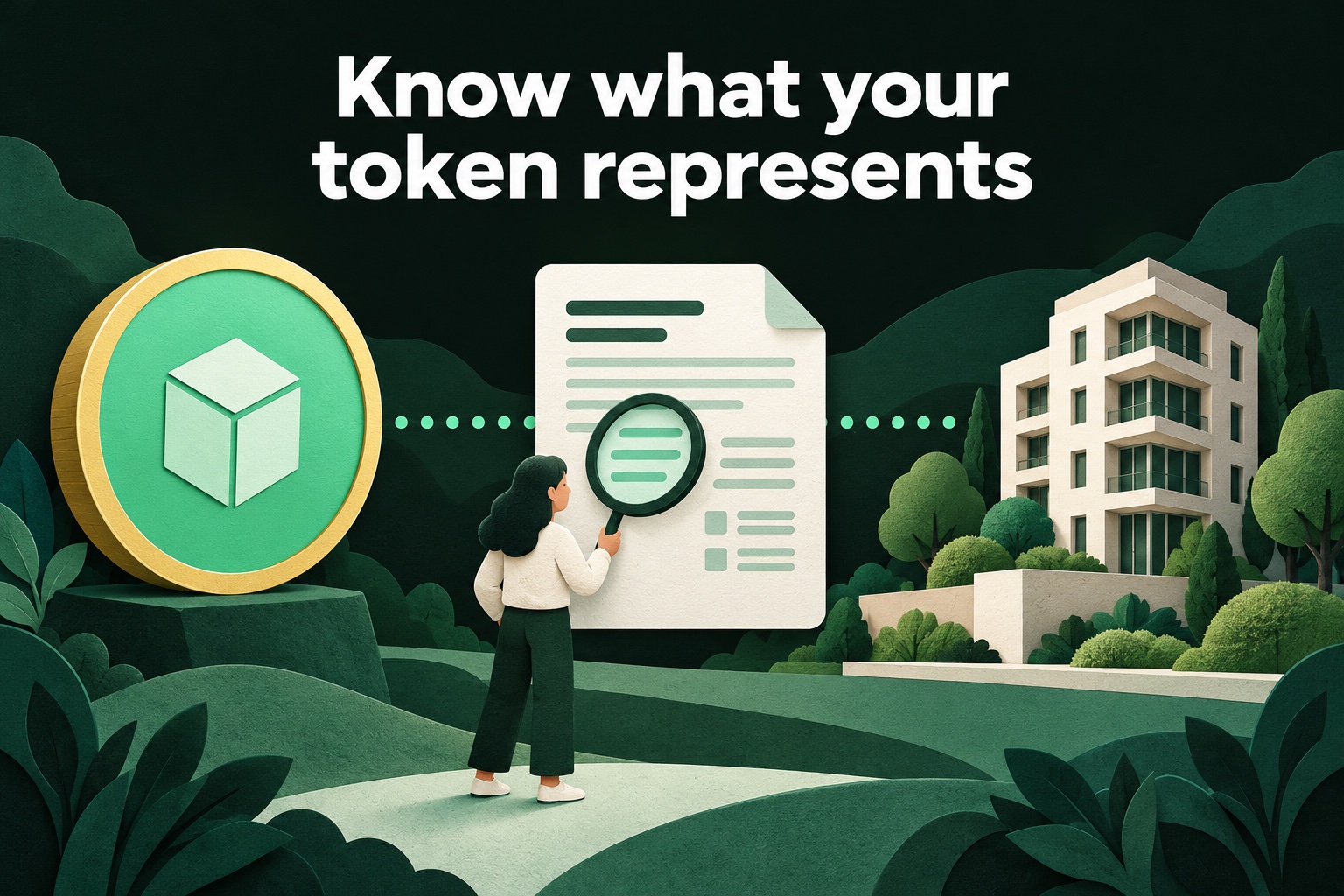
From a familiar claim to a digital record
A token is a digital unit recorded on a shared register, such as a blockchain. Tokenisation means issuing or representing an asset, a right or a claim in that digital form. A claim is an entitlement to something another party is supposed to deliver or pay under an agreement.
This goes beyond trading cryptocurrencies. A bond, for example, is a loan to a company or government, and that financial instrument can be recorded digitally. The European Central Bank discusses tokenisation of financial and physical assets alongside practical, legal and operational questions. Changing the form of the record does not automatically answer those questions.
Imagine a warehouse, not an investment opportunity
Suppose a warehouse agrees to store coffee and a token is intended to give its holder a right to receive a certain quantity. This is a fictional example, not an offered product. The token and the coffee are separate things. Someone still has to hold the coffee and fulfil the agreed delivery.
What happens if the stock is missing, the operator closes or a dispute arises? The token’s picture does not provide the answer. The terms, the parties involved and the applicable law matter. A blockchain record alone does not prove that an asset outside the blockchain exists or that a promise will be honoured. The link needs to be understood, not simply assumed.
Why businesses are exploring it
Digital records can bring together information and some rules for carrying out transactions. A smart contract is a program that performs defined actions on a blockchain. In a suitable arrangement, a transfer might be linked to a payment. That can help coordinate steps and reduce duplicated administration between parties.
These are possible benefits rather than automatic results. Existing systems, reliable information and organizations operating outside the register are often still needed. Costs, access and rules vary between arrangements. A network running around the clock also does not mean every payout or physical delivery can happen immediately. The real-world process has its own limits.
A smaller unit is not automatically a better purchase
Tokenisation can divide some rights into smaller units. But splitting an asset into a hundred digital pieces does not suddenly make it more valuable or safer. The quality of the underlying asset remains important. So do the issuer, the custody arrangements and whether the stated right can actually be exercised.
Being able to transfer a token does not mean there is always a buyer waiting. Liquidity describes how easily something can be sold without a large price adjustment, and it may be limited. Access can also come with conditions. Similar technology can therefore be used for very different products with very different risks.
Read what the token represents
Try explaining an offer in ordinary language first. Who issues the token? What precise right do you receive? Who holds the underlying asset? How would a sale, repayment or delivery work, and under what conditions? What fees or restrictions apply? Find the official documentation rather than relying on an enthusiastic social post.
If the answers are unclear, important information is still missing. A technically polished token is not a substitute for understandable terms. That is the useful idea behind tokenisation: digital records can change processes, but the value of a claim also depends on what happens beyond the screen. You do not need to buy anything to understand that difference.
Original sources & further reading
- ECB — tokenisation, opportunities and limits, April 2026
- BIS — tokenisation and its risks explained
- Financial Stability Board — tokenisation, 22 October 2024
Sources checked on .