Real-World Adoption
Crypto is finding a place behind everyday payments.
Original source published:
When you send money abroad, you care about when it arrives and what it costs. You probably spend less time thinking about how the payment company funds that transfer. That hidden step is where stablecoins can play a role.
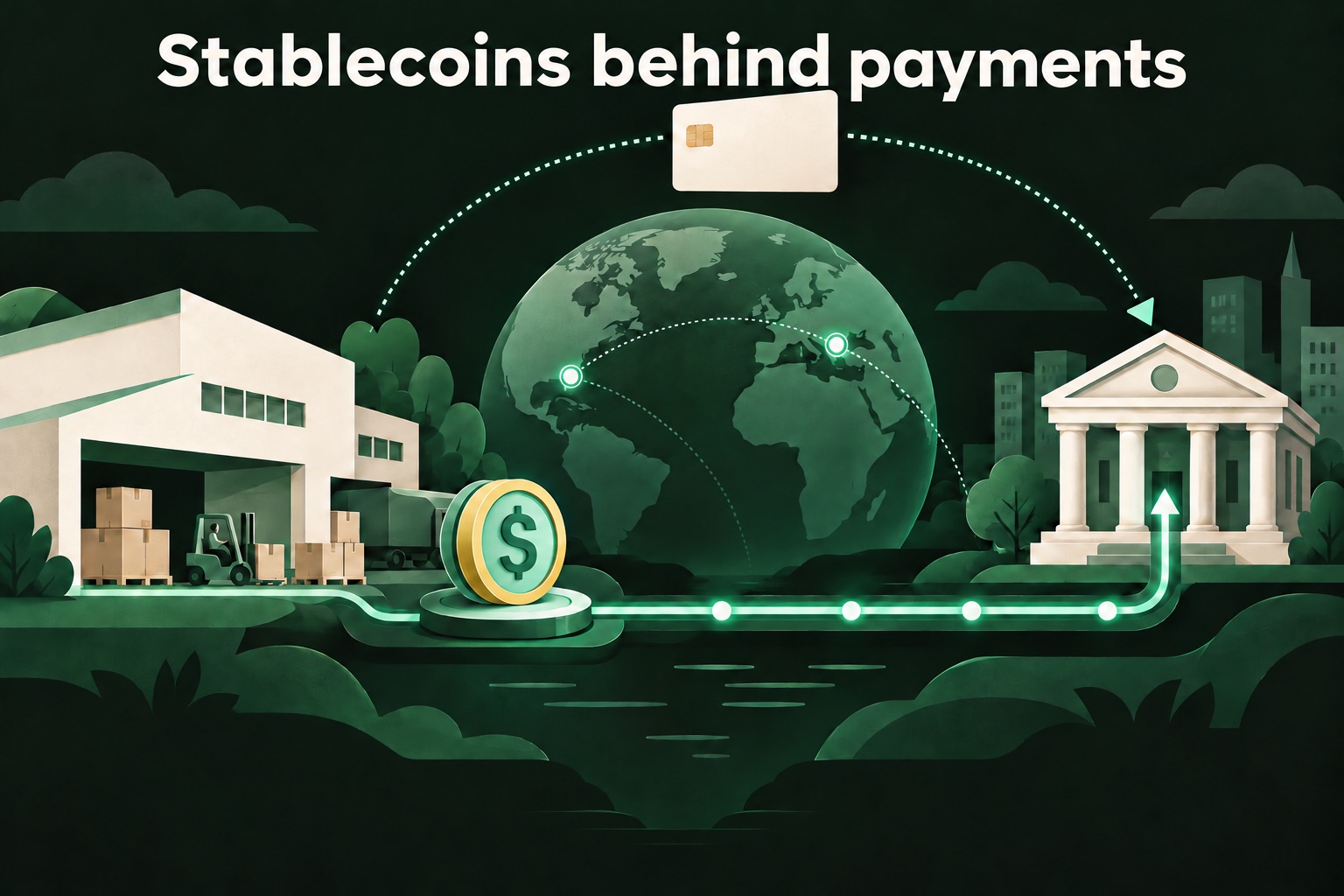
What Visa announced
On 15 October 2026, Visa announced commercial USDC prefunding for Visa Direct through Inyo Global, its first enabler. Eligible businesses can fund cross-border payouts around the clock, in near real time. Access depends on eligibility and geography.
Prefunding means supplying money before outgoing payments happen. Think of a shop topping up its cash drawer before opening: it needs enough money ready to serve customers. A payment company also needs funds available before it can pay people. This story concerns that preparation step.
What is a stablecoin?
A stablecoin is a digital token designed to track a reference value. USDC is issued by Circle and aims to track the US dollar. Circle says it is backed by cash and cash-equivalent reserves. Picture a dollar-denominated digital unit that can move on a blockchain, a shared transaction record maintained by a network of computers.
The word stable describes a target. It does not mean risk-free. Circle’s disclosures describe risks, including a market price that can differ from the dollar target and restrictions on redemption. Converting a token back into ordinary money involves services and conditions. USDC is not covered by deposit insurance.
Why a business might care
Imagine a fictional payment company that serves customers in several countries. More transfers arrive than expected on a weekend. Its staff need to check whether enough money is available along the payment route. Funding flexibility could be useful in that situation.
That is an illustration, not a measured result from this launch. To decide whether a service helps, a business would still need to compare the complete process: buying the tokens, moving them, converting money where needed and completing the payout. Improving one stage does not automatically make the entire journey instant or cheaper.
What this means for an ordinary customer
Payment systems have a visible side and a behind-the-scenes side. You see an amount, a fee and an arrival estimate. The provider handles the funding arrangements. Technology used in the background may change without requiring you to learn a new payment habit.
This business rollout is not an announcement that every Visa cardholder can activate the service. Nor does it establish that every recipient will receive crypto. A funding method and the form of money received are separate questions. Ask your provider what applies to your actual transfer rather than assuming a headline describes your account.
Useful questions matter more than big promises
For a personal transfer, ask: what is the total cost, including currency conversion? When should the money arrive? What happens if it is delayed? Who provides help? Those questions remain useful whatever technology runs in the background.
For a business, add questions about available countries, supported networks, custody and conversion terms. Custody means who holds and controls the assets while a payment is being arranged. Clear responsibility matters as much as a fast funding step.
The practical lesson is that crypto technology can be used for moving money, beyond buying and selling tokens. Whether a particular service is useful depends on its real terms and results. A payments announcement does not predict future cryptocurrency prices or guarantee an investment return.
Original sources & further reading
- Visa — original announcement, 15 October 2026 (including availability footnotes)
- Circle — what USDC is and how its reserves work
- Circle — USDC risk factors and redemption limits
Sources checked on .