Getting Started
You see a crypto balance. But who really controls it?
Two apps can display the same balance and work very differently. With one, you ask a company to move your crypto. With the other, you sign yourself. That difference determines who you rely on when you want to send, lose your phone or can no longer get in.
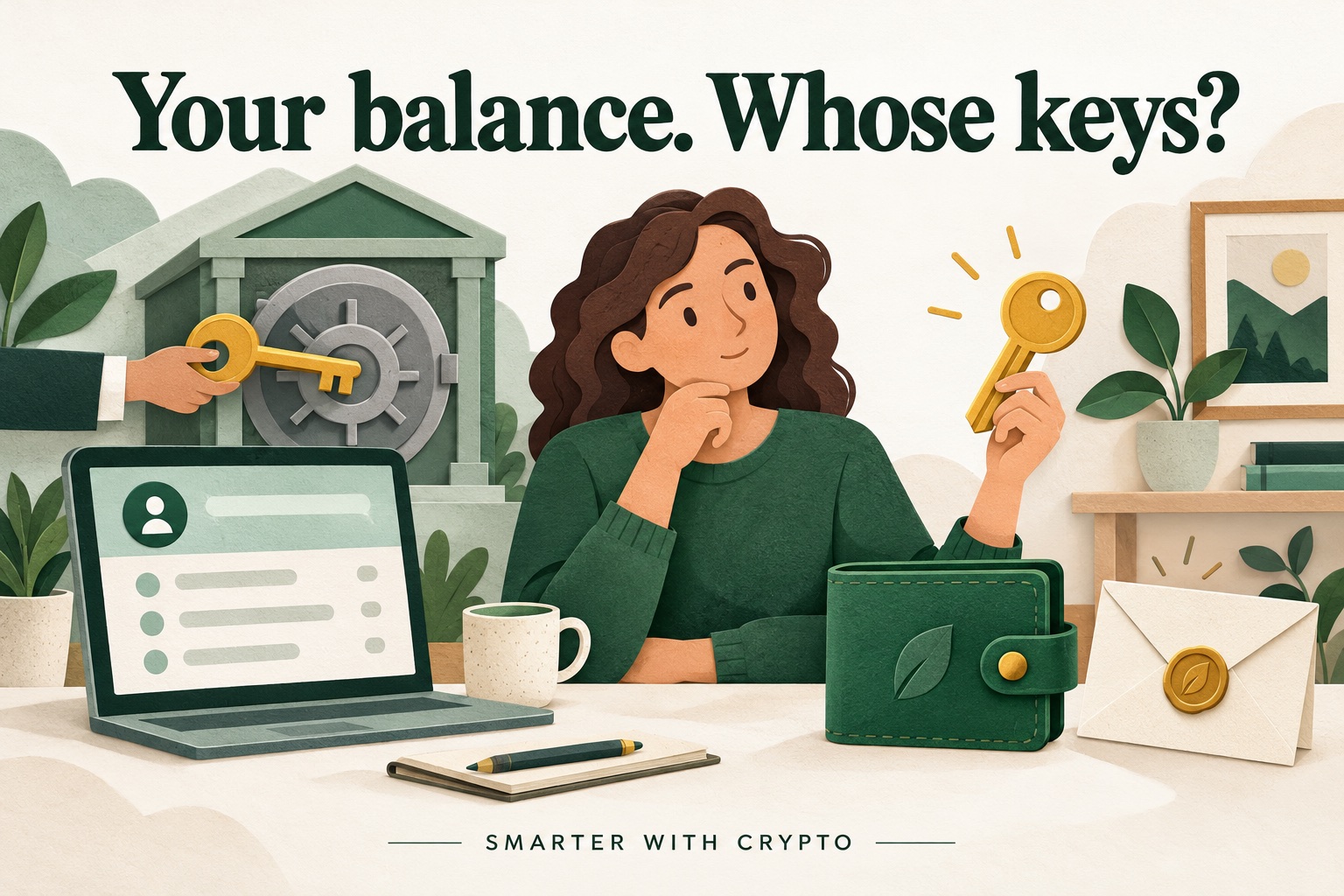
A number on a screen does not tell the whole story
A balance is information. It shows what an app or service associates with your account or address. To understand how much control you have, you need another answer: who can create the digital signature that authorises a transaction? Secret keys are used for that.
A wallet stores or uses those keys; the crypto itself is not a collection of coins inside the app. You can also view an address without possessing its key. Seeing a balance therefore does not prove you can spend it.
With a platform, you give a company an instruction
When a trading platform holds crypto for you, the company generally manages the keys. You sign in and request a withdrawal. The platform processes that request under its procedures, checks and terms. Your password gives access to your account; it is not the key the platform uses to sign a blockchain transaction.
That can feel familiar: there is an account and a recovery process. You also depend on the service. A maintenance pause or account review can mean you cannot withdraw immediately. Legal entitlements depend on the terms and applicable rules; a balance screen does not answer that question.
Self-custody also moves the responsibility
With a self-custody wallet, signing is controlled by you or by a security arrangement you set up. You do not need to ask a trading platform to send a transaction on your behalf. But you do need to understand how your wallet handles access and recovery.
An app code may only lock that app on that device. For many wallets, a recovery phrase can restore access on another device. Other wallets use a passkey or multiple approvers, for example. Check your specific recovery method. Do not assume an email address or help desk can retrieve everything.
The same broken phone, a different next step
Imagine Noor uses two fictional apps. In app A, a company holds her crypto. If her phone breaks, she follows that company's official account recovery process. The company determines the checks required. A new device alone does not give her access.
In app B, Noor controls a wallet with a recovery phrase. She previously made a secure private backup and understands how to restore the genuine wallet. Without that backup and without access on another device, the problem may be permanent. This example is about access, not which provider is better.
Ask three questions before building a balance
Who has to approve a payment? How do I recover access if my device is unavailable? And what could someone else do if they obtained my login details or recovery secret? Find the answers in the official documentation for the exact product, because one brand can offer both a platform account and a self-custody wallet.
Note which recovery route applies, without putting secrets in a public note or chat. Also check that you understand the fees and networks involved in a later transfer. Do not make a large move simply because someone creates urgency or repeats a slogan about holding your own keys.
More control does not protect against every mistake
Self-custody does not automatically protect you against a wrong address, a misleading approval or a price fall. Having a company hold assets does not remove every risk either. The useful choice is the one whose access, dependencies and recovery steps you actually understand.
You can learn this before buying crypto. Use the free quizzes at three levels to practise concepts and practical decisions. A good score does not replace checking the wallet or service you actually use.
Original sources & further reading
- Coinbase — Exchanges and self-custody wallets
- Bitcoin — How wallets and signatures work
- Bitcoin — Securing your wallet
- MetaMask — Recovery methods and password reset
Sources checked on .