Security Alert
This token looks familiar. But is it the one you mean?
You search for a token and recognise its name, ticker and picture. Ready to continue? Pause for a moment. Those details can be copied. A short identity check helps you avoid using a different token from the one you intended. You do not need to buy anything or connect your wallet to begin checking.
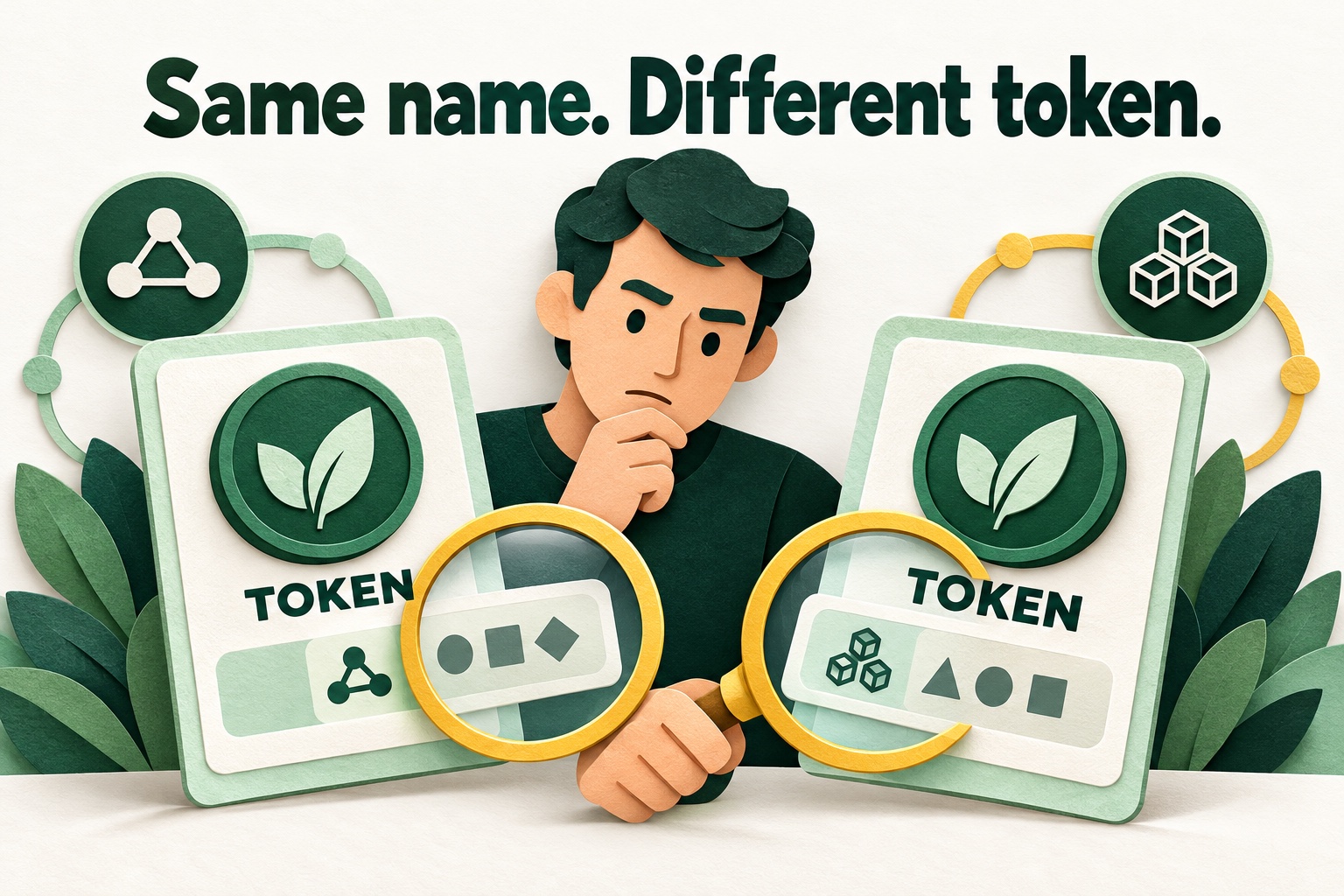
A name is not proof of identity
A token is a digital asset recorded on a blockchain. For many tokens, the creator chooses its name and ticker. Another creator can use the same name. A familiar logo can be copied too. Two search results can therefore look almost identical while referring to different tokens.
Imagine two shops with almost the same sign. The sign helps you recognise something, but it does not establish who runs the shop. With tokens, look beyond the familiar picture. This is an analogy, not a claim about any particular cryptocurrency.
Check the network and the token address
On networks such as Ethereum, a token has a contract address: the address of the program that records that token. This is different from your personal receiving address. Do not simply use it as a destination for sending funds. Other networks may use the term mint address.
First check which network you are using. Then find the official token address for that particular network through the project’s independently checked website or documentation. Compare the complete address with the token details in your wallet or application. The name alone, or just the beginning and end of the address, is not enough.
A simple fictional example
Noor wants to learn about an imaginary token called LEAF. Two search results show the same leaf picture and ticker. She opens a project website she previously checked, selects the intended network and compares its published contract address. One result has a different address.
Noor stops at that result. She does not need to make a small purchase to test whether it is genuine. If official information is missing or contradictory, her conclusion remains uncertain too. She asks through an independently verified official contact point and takes no action in the meantime.
Unrequested tokens are not instructions
An unfamiliar token can appear without you buying it. Receiving it alone does not prove that your wallet was hacked. Risk can arise when you follow a link in its name, try to claim something or sign an unfamiliar permission.
A token may display an attractive value and then lure you to a website to supposedly release it. Never supply your recovery phrase or private key there. Leave suspicious tokens alone; use the wallet’s built-in hide or spam-report feature if available. You do not need to sign a transaction to investigate an unexpected promise.
Correct identity is only one check
A matching address helps establish which token you are viewing. It does not prove that its price will stay stable, that you can sell later or that the project is trustworthy. A wallet warning or verification symbol is not a complete guarantee either.
A warning deserves attention, but an unfamiliar token is not automatically a scam. Conversely, appearing in your wallet does not make a token safe. Treat identity, permission and financial risk as three separate questions. When uncertain, you can simply stop.
Original sources & further reading
- Ethereum.org — How to identify scam tokens
- MetaMask — Token safety practices
- Phantom — Common token scams
- Phantom — Why is my token hidden or flagged as spam?
Sources checked on .