Security Alert
That address looks familiar. But who really owns it?
You want to send crypto again and copy an address from your history. The beginning and ending look right. Your money could still go to someone else. Learn why a familiar appearance is not proof, and what to check before every transfer.
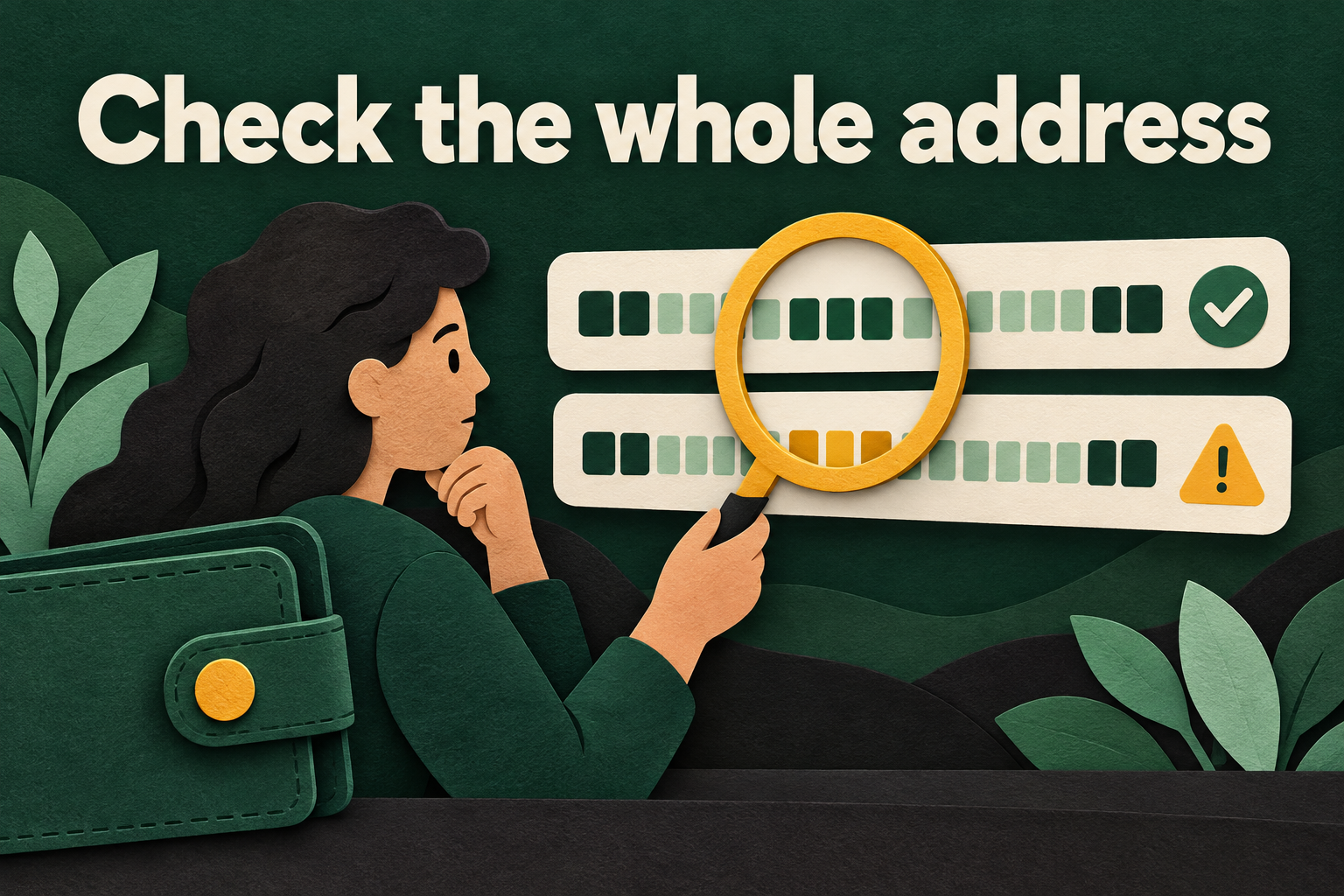
Your history is not an address book
On a public blockchain, a stranger can make a tiny payment or a misleading token entry appear against your address. An attacker may use an address whose first and last characters resemble those of a familiar recipient. The middle differs. This is called address poisoning: your transaction history becomes a way to lure you towards the wrong destination.
The attacker hopes you will later copy that familiar-looking address from the list in a hurry. A wallet showing only the beginning and end makes comparison harder. An address appearing in your history does not prove that you checked it before or that it belongs to your contact.
A strange entry does not automatically mean a hacked wallet
An unexpected tiny or zero-value entry alone does not prove that someone knows your secret keys. Some token entries can look as though you sent something, even though you transferred no real value. Check the transaction type and whether your actual balance changed.
Do not follow a link in an unfamiliar token name or casually try to sell or return the token. You do not need to sign anything to ignore a strange address. If you do find a real outgoing payment you did not authorize, take it seriously and follow your wallet's official security guidance. An explanation for spam is not proof that every strange transaction is harmless.
Noor checks more than the ends
In this fictional example, Noor has paid her friend before. Today she sees two addresses whose beginnings and endings look the same. She nearly copies the newest one, but asks her friend through their usual contact channel for the current receiving address on the correct network.
She opens the complete address in her wallet and compares every character against that confirmed destination, including the middle. One address differs. Noor uses the checked destination and saves it with a clear name. The lesson applies across apps: a recent entry does not prove who the recipient is.
Make checking part of the routine
Get the destination from your own account's official receive page or directly from the intended recipient through a trusted channel. Check the network, complete address and any required memo or tag. A correct address on an unsupported network can still cause problems.
After pasting, check what actually appears in the send field. With a hardware wallet, also compare the destination on the device with your trusted source. The device can show what you are signing; it does not automatically know which person you intended to pay. Do not confirm if details differ or you cannot inspect them fully.
A test does not replace the next check
A small test can help establish whether a checked route works. For a later payment, do not blindly copy the latest address in your history: a misleading entry may have appeared in between. Use the confirmed destination again and check the complete details for every transfer.
Wallet warnings and a carefully created address book are useful extra tools. They do not replace your check. If uncertain, pause. You do not need to send money to practise this: test your knowledge with the free quizzes at all three levels.
Original sources & further reading
- MetaMask — Address poisoning scams
- Ledger — Address poisoning attacks
- MyEtherWallet — Strange or unexpected transactions
- Etherscan — Address Poisoning Attacks
Sources checked on .