Getting Started
Bitcoin: everyone knows the name, but what is it really?
You have undoubtedly heard about it. On television, in the newspaper, through friends or on social media. Perhaps you have even bought Bitcoin yourself. But do you actually know what Bitcoin is, why it was invented and what it could mean for you?
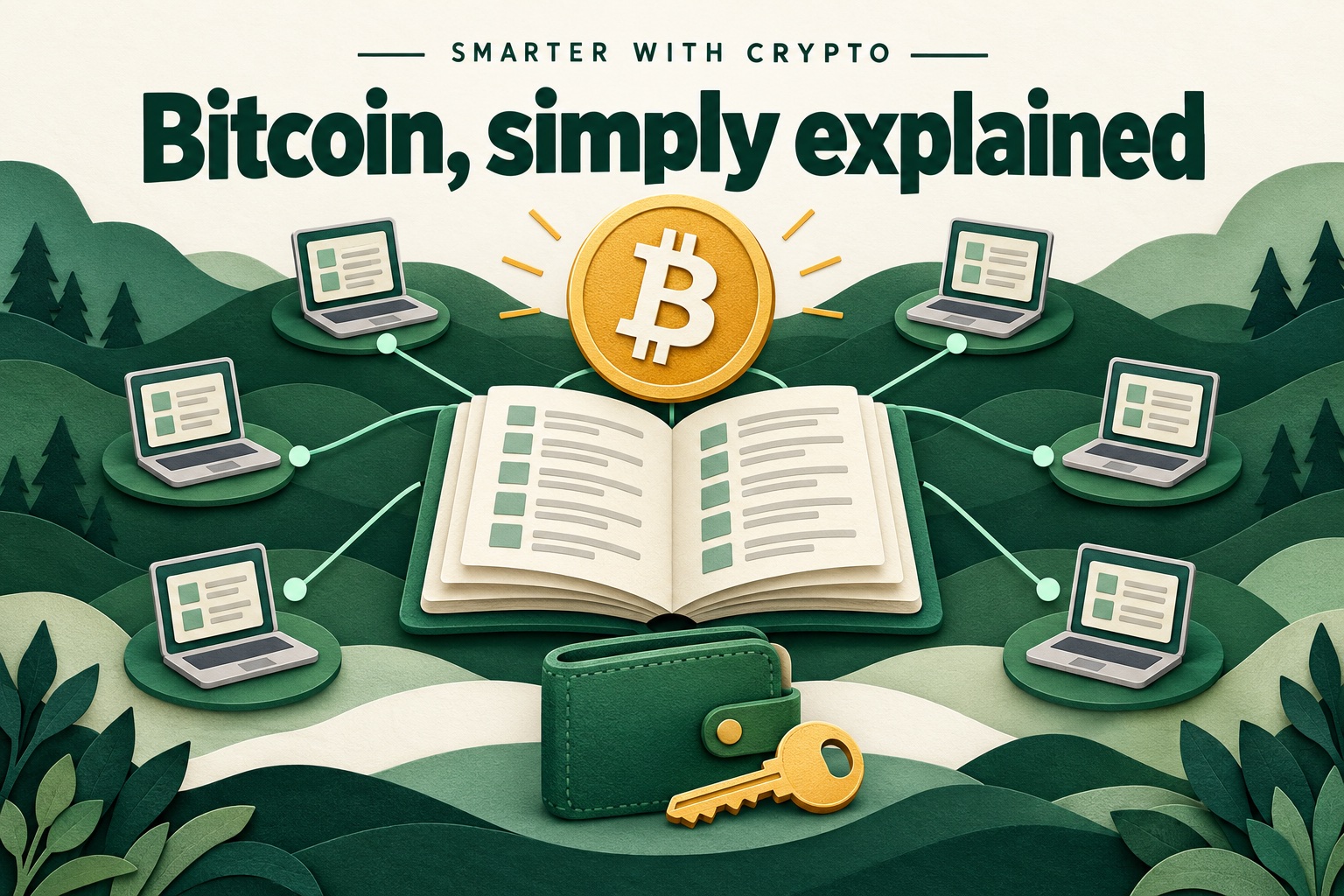
We explain it without difficult technical terms. Because you do not need to be a computer expert or financial specialist to understand Bitcoin.
💡 What actually is Bitcoin?
Imagine being able to send money to someone on the other side of the world, without needing a bank to carry out the payment.
That is the basic idea behind Bitcoin.
Bitcoin is digital money that works without a central bank or any other central administrator.
You cannot hold it like a coin or banknote. It exists entirely digitally, but people can send it to each other, receive it, store it and trade it.
What makes it special? No company, bank or government controls Bitcoin on its own.
🕰️ Why was Bitcoin invented?
In 2008, the world experienced an enormous financial crisis. Several major banks ran into trouble and governments had to intervene to keep the financial system afloat.
That year, an unknown person, or group of people, using the name Satoshi Nakamoto published a document proposing Bitcoin.
In January 2009, the Bitcoin network actually launched.
The idea was revolutionary: why do we always need a bank or another intermediary to transfer digital money to each other?
Bitcoin was designed as an alternative that allows people to exchange value directly, with control not resting with one central organisation.
That does not mean banks suddenly become unnecessary. Bitcoin simply offers a different way of dealing with money.
🔗 How does Bitcoin work? More simply than you think.
Imagine a large digital ledger somewhere.
That ledger records how much Bitcoin is sent from one digital address to another.
But instead of one bank keeping the ledger, thousands of computers around the world have access to the same information.
We call that ledger the blockchain.
When someone sends Bitcoin:
- The payment is sent to the Bitcoin network.
- Computers check whether the payment follows the rules and whether the sender is authorised to spend the Bitcoin.
- Special computers, called miners, collect transactions into blocks and secure the network.
- Once such a block is accepted, the payment is recorded in the blockchain.
A new block appears approximately every ten minutes on average.
Anyone can check the transactions. There is therefore no need for a bank to keep a central ledger.
Think of it as a set of accounts that thousands of people have a copy of. If someone secretly tries to change an amount, the other computers will not simply accept it.
That makes manipulating the blockchain particularly difficult.
🪙 Why do you always hear about those 21 million Bitcoin?
This is one of Bitcoin's most important features.
Under the current network rules, a maximum of approximately 21 million Bitcoin can exist.
Not 30 million. Not 100 million. Approximately 21 million.
New Bitcoin gradually enter circulation as a reward for miners. That reward is halved approximately every four years, so fewer and fewer new Bitcoin are added.
Think of gold.
Gold is valuable partly because it is scarce. You cannot simply produce unlimited quantities of new gold.
Bitcoin has a similar form of scarcity, but it is digitally defined in the network's rules.
That does not automatically mean Bitcoin will always become more valuable. Scarcity alone does not make something valuable. There also need to be people who want to own or use it.
🔐 Who actually controls your Bitcoin?
For that, you need to know one important concept: the digital wallet.
A wallet is an application or device that lets you manage Bitcoin.
Your wallet contains the secret digital keys that allow you to prove you are authorised to send your Bitcoin.
Think of it as the key to a safe.
Whoever manages the key generally has control over the Bitcoin.
But there is an important distinction.
When you buy Bitcoin through a trading platform, that platform sometimes keeps the keys for you. You then depend on the security and terms of that company.
With your own wallet, you can keep your keys yourself and act more independently.
That gives you freedom, but also responsibility.
If you lose access to your own wallet and have no secure backup, your Bitcoin may become permanently inaccessible.
🛡️ What guarantees does Bitcoin offer you?
This may be the most important question.
Bitcoin offers strong technical properties, but no financial guarantee.
What can you expect from the system?
- Transparency: anyone can check the blockchain and the transaction rules.
- Predictable issuance: the current rules determine how much new Bitcoin is added and limit the total number.
- Independence: with your own keys, you can carry out transactions without permission from a bank.
- Strong security: cryptography and a worldwide network make falsifying confirmed transactions particularly difficult.
- Global accessibility: anyone with the necessary technology and internet access can, in principle, use the network.
But what does Bitcoin not guarantee?
- No guarantee that its price will rise.
- No protection against price falls.
- No automatic refund if you send to the wrong address.
- No guarantee that you will recover lost or stolen Bitcoin.
- No bank deposit guarantee like that covering certain traditional savings accounts.
Bitcoin's technical rules are also not literally unchangeable. A change requires network participants to accept new rules.
Bitcoin gives you the opportunity to take control yourself. But it does not remove the financial risks.
📈 Why does the price rise and fall so sharply?
That is mainly due to supply and demand.
When more people want to buy Bitcoin than sell it, the price can rise.
When many people sell and there are not enough buyers at the current price, it falls.
News, regulation, economic developments and investor confidence can all have an influence.
That is why Bitcoin can rise sharply today and suddenly lose a large part of its value tomorrow.
It is important to understand this before you consider buying Bitcoin.
🌍 Is Bitcoin the future of our money, then?
Nobody knows for certain.
Some people see Bitcoin as digital gold: something they want to hold for a longer time because of its limited quantity.
Others see it as a means of payment that lets you send money worldwide without a traditional bank.
And others mainly see Bitcoin as a risky investment.
All of these uses exist, but the future will have to show how important Bitcoin ultimately becomes.
🎯 What should you remember most?
Bitcoin is much more than a price that moves up and down every day.
It is a technology that, for the first time on a large scale, made it possible to exchange digital value directly between people without one central institution having to manage the system.
It gives users new possibilities, but also requires them to understand how to manage their digital assets safely.
You do not have to buy Bitcoin to learn about it.
Because understanding Bitcoin is not the same as investing in Bitcoin.
And that is exactly where good crypto education begins: understand first, then decide.
📚 Smarter With Crypto — Part of Welcome to Web3
Understanding crypto, step by step and without complicated jargon.
This article is intended solely for educational purposes and does not constitute financial or investment advice.
Original sources & further reading
Sources checked on .